
A new kitchen, reception desk or lobby without the demolition — new finishes applied over what is already there.
Architectural finish film is a surface material that is applied over what is already there. Instead of ripping out a dated reception desk, a set of elevator doors or a wall of melamine cabinets and replacing them, the existing surface is wrapped in a film that looks and feels like wood, stone, concrete or brushed metal. The result reads as new millwork, and nothing was demolished to get it.
Caspian Signs & Graphics installs architectural finishes for homes, offices, lobbies, clinics, hotels, retail and strata buildings in Vancouver, Burnaby, North Vancouver and across British Columbia. We have wrapped three complete kitchens as well as commercial millwork, so this is work we do rather than a service we have added to a list. It is detail work rather than large-area printing — the result depends almost entirely on the preparation and the edges.
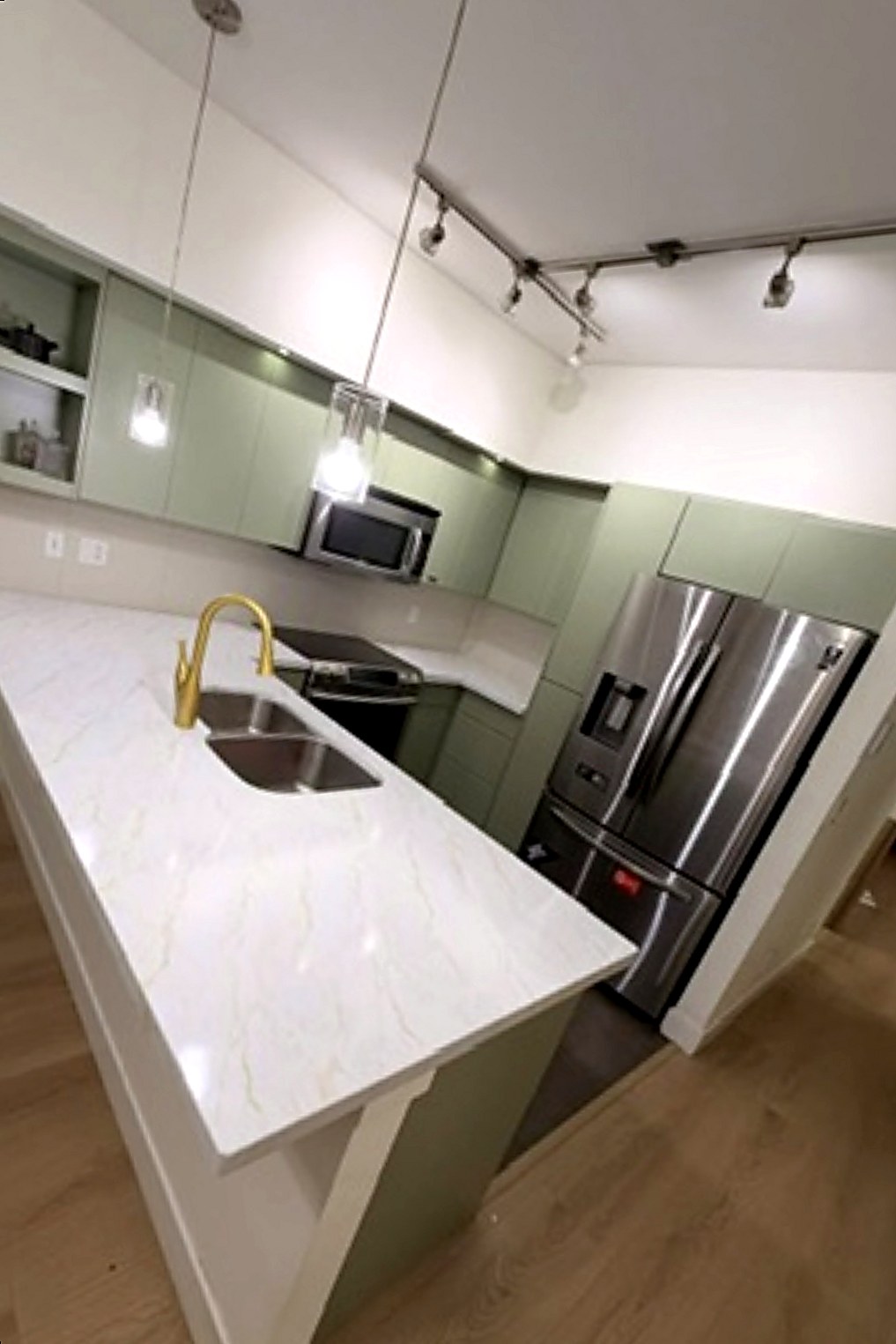
A Vancouver condo kitchen we wrapped — the original cabinet boxes and doors, refinished in two tones. No demolition, no joiner, no new cabinets.
The argument is usually financial and it is usually decisive. Replacing millwork in an occupied building means demolition, disposal, a joiner, finishing trades, dust, noise and a space out of use for weeks. Wrapping the same millwork is a fraction of the cost, it happens overnight or over a weekend, it produces no dust and no debris, and the space is usable the next morning.
There is a second argument that matters in leased space: it is reversible. A tenant can transform a dated suite without altering the landlord’s asset, and the film comes off cleanly at the end of the term. For anyone who has read a make-good clause carefully, that is worth a great deal.
Architectural finishes are quoted per item and per surface, not by the square foot alone, because the labour is in the edges and the corners rather than the open area. A flat cabinet door is quick; a curved reception desk with a returned edge and a cut-out is not.
Send us photographs of each surface with measurements and we will quote it item by item. The comparison worth making is against a quote to replace the same millwork — that is the number this usually competes with, and it is rarely close.
| Surface complexity | Flat panels are quick. Curves, returns, recessed handles, cut-outs and profiled edges are all slow, careful work. |
|---|---|
| Number of edges | A single large panel costs less than the same area split into twelve cabinet doors, because every door has four edges to wrap. |
| Condition of the substrate | Film follows whatever is underneath. Dents, chips and lifting laminate have to be made good first or they show through. |
| Film pattern | Plain colours and fine textures are straightforward. Directional wood grain and stone patterns have to be matched across adjoining panels. |
| Removal of old finish | Taking off existing film, laminate or peeling veneer before starting. |
| Access & hours | An empty space during the day is cheapest. An occupied lobby overnight costs more. |
| Hardware | Handles, hinges and trim usually need removing and refitting so the film can be wrapped behind them properly. |
The ranges run far beyond what people expect, and the better films are convincing because the texture is embossed into the surface rather than printed flat — a wood grain film has grain you can feel under your hand, which is what makes it hold up to close inspection.
Film is unforgiving in a way that printed graphics are not. On a wall mural, a slight imperfection underneath disappears into the image. On a flat matte wood-grain finish, every dent, every chip and every speck of dust under the film is visible at arm’s length, in raking light, forever.
So most of the work is preparation. Surfaces get cleaned and degreased properly, damage gets filled and sanded, lifting laminate gets secured or removed. Hardware comes off so the film can be wrapped around and behind edges rather than cut to meet them — a wrapped edge is what makes the panel look like a solid object, and a cut edge is what makes it look like a sticker. On patterned films, the grain direction is set out across adjoining panels before anything is applied, because grain running the wrong way on one cabinet door is the kind of mistake you cannot stop seeing.
This is slow, quiet work and it is worth asking any supplier how they handle edges and hardware before you compare prices. A cheaper quote usually means cut edges and hardware left in place.
Kitchens are the job this material was made for, and in Vancouver they are also the job that makes the most financial sense. A condo kitchen from the early 2000s is usually structurally fine — the boxes are sound, the hinges work, the layout suits the room — and what is actually wrong with it is the colour. Replacing the whole thing to fix a colour is an expensive way to solve that problem.
We wrap the doors, drawer fronts, end panels and the exposed sides of the boxes. The kitchen keeps its layout and its hardware, and comes back a different colour and a different finish. We have done three complete kitchens this way.
If you live in a strata building, a full kitchen renovation is not only a cost problem. It is a permit question, a noise-hours question, a neighbour question, an elevator-booking question, and several weeks without a kitchen. Most strata councils have rules about renovation hours, and a demolition in a concrete building is heard on three floors.
Wrapping avoids nearly all of that. There is no demolition, no dust, no disposal bin, no plumbing or electrical work, and nothing structural — so in most buildings it does not trigger a renovation approval at all, though you should always check your own strata’s rules. It takes days rather than weeks, and the kitchen stays usable through most of it.
| Flat slab doors | The ideal candidate. Modern condo kitchens from the last twenty years are usually flat slab, and they wrap beautifully — clean edges, no profile to work around. |
|---|---|
| Handleless or edge-pull doors | Also excellent, and often better than the original, because there is no hardware interrupting the surface. |
| Melamine and laminate boxes | What most condo kitchens are made of, and a good substrate. Sound melamine takes film well. |
| Shaker and profiled doors | Possible, but slower and more expensive, because the film has to be worked into every profile. Sometimes replacing just the doors and wrapping the boxes is the better answer. |
| Damaged or swollen doors | Water-damaged particle board under the sink, or doors with swollen edges, has to be repaired or replaced first. Film follows whatever is underneath. |
| Real wood with heavy grain | Deep open grain can telegraph through. Sanding and filling first, or accepting a textured result. |
Because the film is applied piece by piece, splitting a kitchen into two colours costs no more than one — it is the same labour. Dark lowers with light uppers, or an island in a different colour from the perimeter, is a choice rather than an upcharge. So is changing the finish while keeping the colour: the same white in matte instead of gloss reads as a completely different kitchen.
| Condo kitchens, region-wide | Yaletown, Olympic Village, Metrotown, Brentwood, Lonsdale, Richmond — towers from the 2000s with sound kitchens in dated colours. The single best use of this material. |
|---|---|
| Downtown office towers | Elevator doors and cab interiors, lobby reception desks, suite doors. Done overnight because the lobby cannot close. |
| Strata residential buildings | Lobby refreshes between the building’s own renovation cycles — elevator doors, mail room, amenity room millwork. The cheapest visible improvement a strata council can approve. |
| Yaletown & Gastown | Creative offices in brick buildings, where metal and timber finishes suit the architecture better than paint. |
| Clinics on Broadway & Cambie | Reception counters and cabinetry brought up to date without closing the practice for a renovation. |
| Retail — Robson, Oakridge, Metrotown | Fixture and fitting-room surfaces refreshed between fit-outs, often on a brand’s standard finish schedule. |
| Hotels & hospitality | Guest room doors, corridor millwork and lobby surfaces, done floor by floor so the hotel keeps trading. |
| Metrotown & Brentwood, Burnaby | Office and mixed-use towers. Building standards often set the finish, and matching an existing one matters. |
If you are looking after a building that is showing its age but is not due for a full renovation, this is usually the most visible improvement available per dollar. A lobby with wrapped elevator doors, a wrapped reception desk and refinished mail room millwork reads as recently renovated, and none of it required a permit, a trade schedule or closing the lobby.
It also works in stages. One elevator bank this quarter, the corridor doors next, the amenity room after that — and because we keep the finish specification on file, the work done next year matches the work done today. Send us photographs and we will quote it in the order you want to do it.
Yes — we have wrapped three complete kitchens. We wrap the doors, drawer fronts, end panels and exposed box sides, keeping your layout and hardware. Flat slab doors, which is what most condo kitchens have, are the ideal candidate.
Days rather than weeks, and the kitchen stays usable through most of it. There is no demolition, no disposal bin and no plumbing or electrical work.
Usually not, because nothing structural is altered and no demolition or trade work is involved — but every building is different, so check your own strata’s rules. It is worth noting that there is also no noise, no dust and no disposal bin, which is normally what a strata is concerned about.
Yes, at no extra cost. Because the film goes on piece by piece, dark lowers with light uppers, or an island in a different colour, is the same labour as doing it all in one colour.
Interior architectural film is made for this and handles normal kitchen use. The areas that need care are the same ones that fail in any kitchen: directly beside a cooktop, and anywhere water sits. We will tell you if a particular spot in your kitchen needs a different approach.
The better films are convincingly close, because the texture is embossed rather than printed — you can feel the grain. At arm’s length on a well-prepared surface with wrapped edges, most people do not identify it as film. On a badly prepared surface with cut edges, everybody does.
Interior architectural film is a long-term finish, not a temporary one, and holds up for many years on vertical surfaces. High-contact horizontal surfaces such as a counter top where things are dragged across it wear faster than a door or a column.
Yes, which is one of the main reasons it is specified in leased space. It comes off cleanly and leaves the original surface as it was, so a make-good clause is satisfied.
Yes, and that is how it is normally done — one elevator at a time, usually overnight, so the building keeps running. There is no dust and no debris, which is why this works where a renovation does not.
Sound and clean. Film follows whatever is underneath, so dents and chips have to be filled and sanded first or they show through. We will tell you honestly what needs making good before we start, rather than wrapping over a problem.
Substantially, in almost every case, and the saving is bigger once you count the disruption. There is no demolition, no disposal, no joinery lead time and no weeks of a space being unusable.
Usually. Send us a photograph in daylight and, if you can, the name of the existing finish. We will find the closest match and show you a sample before committing to the whole job.
No. Wall graphics are printed images and murals applied to walls. Architectural finishes are textured surface materials applied to millwork, doors, columns and fixtures to change what they are made of — or appear to be made of.
We install architectural finish film on reception desks, elevator doors, millwork, columns, doors and fixtures for offices, lobbies, clinics, hotels, retail and strata buildings across Vancouver, Burnaby, North Vancouver and the rest of British Columbia.
Caspian Signs & Graphics carries liability insurance and WorkSafeBC coverage, so your project is protected from start to finish.
Or call +1 236-591-3235 — we answer during shop hours.
Also see: Office Graphics | Window Film | Wall Graphics | Wayfinding Signage | Retail Display Installation | Sign Shop in Vancouver, BC | Sign Shop in Burnaby, BC