
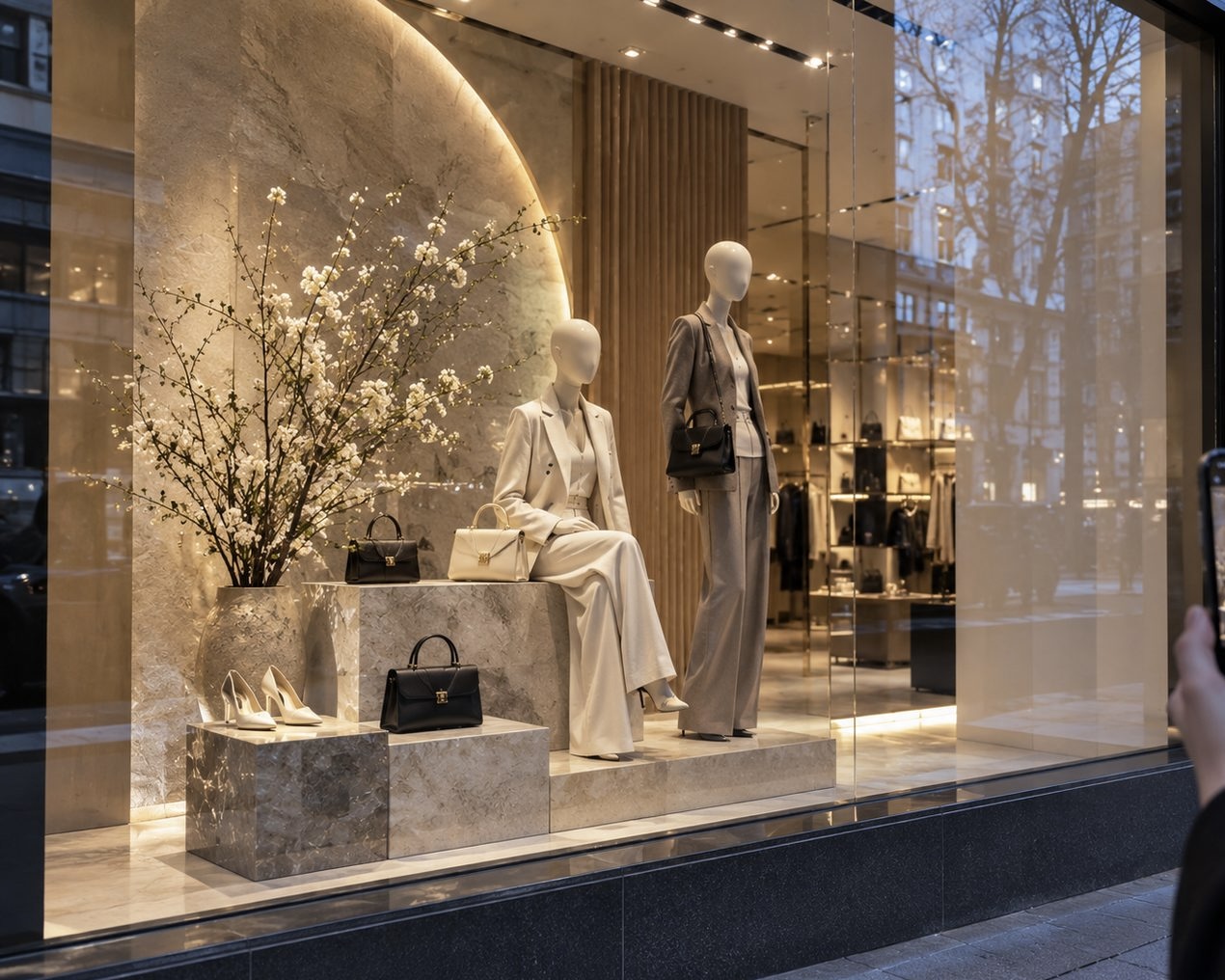
Professional installation of retail displays, branded environments and visual merchandising elements shipped from anywhere in the world to Vancouver, Burnaby and the Lower Mainland.
Your display ships to Vancouver. We handle the local installation.
For a brand head office, flying a crew to British Columbia for one store is expensive and slow. We are the local pair of hands instead: we receive the shipment, read your installation guides, work to your standards, and send you photos when it is done.
Retail installations start at around $400.
Price is driven by labour — how many installers, for how long, and at what time of day. A single window display or a set of graphics sits near the lower end; a full fixture package across a store, or a rollout across several locations, is quoted per site.
Every quote separates receiving, labour, equipment and any disposal, so your finance team can see exactly what they are approving. Nothing is added afterwards.
| Scope | A window refresh, a fixture package and a full store build are very different amounts of labour. |
|---|---|
| Crew size & hours | Some installs need two people for an afternoon; others need a larger crew overnight. |
| Time of day | After-hours and overnight work in occupied malls costs more than daytime access. |
| Receiving & storage | Taking delivery, checking the shipment against the packing list and holding it until install day. |
| Site access | Loading dock bookings, freight elevators, mall rules and parking all add time. |
| Equipment | Ladders are included; lifts and specialty tools are quoted separately. |
| Number of locations | Multi-store rollouts are quoted per site, and the per-site cost usually drops. |
| Disposal | Removing old fixtures and taking away packaging and waste. |
Freight rarely arrives on the day you want to install. We can take delivery ahead of time and hold the shipment until the install date, which also means we open the boxes early. If a crate has been damaged in transit or a part is missing, you hear about it with time to do something, instead of at eight o'clock on install night.
Most retail work happens when the store is closed. We are set up for evening and overnight installs, and we are used to mall requirements — dock bookings, certificates of insurance, contractor sign-in and quiet hours. We carry liability insurance and WorkSafeBC coverage, so the paperwork side is straightforward.
A lot of our retail work does not come from the store. It comes from a visual merchandising company, a display fabricator, or a brand's own merchandising team that has the design finished and needs someone in British Columbia to put it in. We are that crew. We do not compete with you for the creative work — we have no merchandising studio and we do not write planograms. We install.
If you are a merchandising company in Vancouver or anywhere else, the arrangement is usually simple. You own the client relationship and the design; we are the hands on site. You send the drawings, the shipment and the schedule; we confirm access, do the install, and send you the photographs you pass on to your client. We invoice you rather than the retailer, and we will stay entirely behind the scenes if that is how you prefer to work.
The same applies across the border. We work as the Canadian installation subcontractor for European and US retail fit-out, display and visual companies that have no crew on this side of the Atlantic. You keep the client; we are the hands in Canada.
| Concept & design | Yours. We will say early if something will not physically work at that address, but the design decisions are not ours to make. |
|---|---|
| Production | Usually yours or your fabricator's. If a panel needs printing, cutting or remaking locally, we can produce it here instead of shipping it across the country twice. |
| Freight & receiving | Ours, if you want it. We can be the Vancouver consignee, check the shipment against the packing list and hold it until install day. |
| Site access & paperwork | Ours. Dock bookings, freight elevators, contractor sign-in, certificates of insurance, after-hours entry. |
| Installation | Ours, to your drawings and the brand standard. |
| Sign-off | We photograph the finished install and send it to you. You present it to your client. |
Retail merchandising is rarely a one-off. Windows change with the season, product merchandising changes with the campaign, and fixtures get moved more often than anyone plans for. Individually these are small jobs, and they are awkward to staff from out of province — which is exactly why a local crew is worth having on file. We keep measurements and photographs from previous visits to your stores, so the second changeover takes less time than the first and nobody has to explain the site again.
We are not a visual merchandising agency. We do not do store planning, product placement strategy, planogram compliance auditing or field-marketing head counts. If that is what you need, you need a merchandising company — and we are happy to be the installer they bring in. Saying this plainly up front saves everybody a meeting.
If you are planning a store install from a head office in another city or another country, the address matters more than it looks on a map. Two stores ten minutes apart can have completely different access rules, different loading arrangements and different hours you are allowed to work. Here is what each of the main retail areas means in practice.
| Robson Street | Flagship territory, and the hardest access in the city. Narrow storefronts, no loading dock, time-limited loading zones and heavy pedestrian traffic. Freight gets staged elsewhere and brought in, usually early morning or after closing. |
|---|---|
| Alberni Street | The luxury row. Brand standards are strict, security is involved, and installs are almost always after hours with the glass papered off. Expect the brand's own guidelines to govern every detail. |
| CF Pacific Centre & downtown malls | Underground, so everything moves through a booked dock and a freight elevator. Contractor sign-in, certificate of insurance and quiet hours all apply. The booking is often the longest lead time in the job. |
| Metropolis at Metrotown, Burnaby | The largest mall in British Columbia. Good dock facilities, but busy — dock slots need booking well ahead, and overnight work is the norm. |
| Brentwood & Lougheed, Burnaby | Newer centres with newer rules. Generally easier access than downtown, with proper loading and service corridors. |
| Holt Renfrew, Dunsmuir Street | Shop-in-shop concessions, counters and brand corners inside the store. The store's own vendor rules sit on top of everything else: approved contractor paperwork, after-hours access only, freight through the store dock, and the space cleared and clean before doors open. Nothing gets left half-finished overnight. |
| Oakridge Park & the Cambie corridor | The rebuilt Oakridge centre, with tenant fit-outs running more or less continuously. Coordination with other trades on site is usually part of the job, and dock access is shared with whoever else is building that week. |
| Richmond — CF Richmond Centre, Aberdeen, McArthurGlen | Close to the airport, which matters when freight clears customs at YVR. Bilingual signage is standard here, so check your artwork covers it before it ships. |
| South Granville, Gastown & Main Street | Independent boutiques in older and heritage buildings. Narrow doors, tight stairs, uneven floors — measure twice, because a fixture that fits the drawing may not fit the doorway. |
| Park Royal, Guildford, Coquitlam & Kitsilano West 4th | Suburban centres and street retail outside the core. Easier parking and access, longer travel time, which shows as its own line on the quote. |
Head offices tend to budget for labour and forget about getting the crates to the door. In downtown Vancouver that is frequently the harder half. Robson and Alberni storefronts have no loading dock at all; the loading zones are time-limited and enforced, and anything that blocks a lane needs a City permit arranged in advance. Inside a mall, the freight elevator and dock slot are booked resources, and if the booking is missed the crew cannot work no matter how many hours you have paid for.
This is the part we take off your desk. We confirm the access route before install day, book what needs booking, and tell you plainly if the schedule you have in mind is not possible at that address — while there is still time to change it.
Installing a brand concession inside a department store such as Holt Renfrew is not the same job as installing in your own leased storefront, even though the fixtures may be identical. You are a vendor working inside somebody else's trading floor. That means the store's contractor requirements, its insurance documentation, its access hours and its cleaning standard — and a hard stop before opening, because the floor has to look finished when the first customer walks past. We plan these as a single overnight block with the tools and spare parts on site from the beginning, since there is no going back to the van for something at three in the morning.
Displays shipped from Europe or Asia usually land at the Port of Vancouver or at YVR, clear through a customs broker, and then sit with a local carrier until someone takes delivery. That last step is where projects stall when there is no local address. We can be the consignee: we receive the shipment, check it against the packing list, photograph anything damaged, and hold it until the install date. For Richmond stores in particular this is short and simple, because the freight is already in that part of the region.
This catches head offices out more often than anything else on this page. Light fittings, transformers and powered display units built for the European market almost never carry a CSA or cUL certification mark, because they were never made for the North American market. In Canada, electrical equipment without a recognised certification mark cannot simply be wired in and switched on — it needs a field evaluation, the CSA SPE-1000 special inspection, before an inspector will allow it to be energised. That is an extra cost, an extra booking, and a lead time nobody put in the schedule.
We have run into this, so we raise it before the crate ships rather than on install night. Tell us early what is powered and where it was made, and we will tell you whether it will pass as it is, whether the fitting is better sourced here as a certified equivalent, or whether an inspection needs booking. Quite often the cheapest answer is to ship the décor and buy the lighting locally.
If you are rolling a concept out across Canada, splitting it between four unrelated local contractors means four quoting formats, four standards of finish and four sets of photographs that do not look like each other. We can take the whole thing instead.
Vancouver and the Lower Mainland we install ourselves. For Calgary, Edmonton, Toronto and Montreal we work with installers we know and have worked with, and we manage the job: the same scope, the same brief, the same reporting back, one invoice and one person to call. We will always tell you which crew is ours and which is a partner — you should know who is standing in your store.
Québec's French-language signage rules are stricter than the rest of Canada, and they tightened on 1 June 2025. On public signage carrying a trademark in another language, French now has to be markedly predominant — it must have a clearly greater visual impact than the other language. A décor package designed in Paris or New York and shipped identically to every Canadian store will often be fine in Vancouver and Toronto and not compliant in Montreal. It is worth having the Montreal artwork checked separately, before the whole run is produced rather than after.
If your company is in New York, London, Milan, Madrid or Paris and you have a store to fit out in Canada, the awkward part is rarely the installation itself. It is having nobody on the ground: no address for the freight to go to, nobody to book the dock, nobody to walk the site and tell you what is actually there rather than what the drawing says. That is the gap we fill.
You keep the client and the creative. We invoice you rather than the retailer, we work under your project name, and we do not approach your client — before, during or after. If you would rather our name never appears anywhere on the job, it does not. Trade-only and white-label arrangements are normal for us and we are happy to sign whatever confidentiality agreement you work under.
These are two different roles and the difference matters more than people expect. We can be the consignee: the Canadian delivery address on the paperwork. We take the delivery, check it against the packing list, photograph anything damaged in transit, and store it until the install date.
We are not the importer of record. Duties, taxes and customs clearance stay with you and your customs broker. Nearly every company we work with already has a broker who clears the shipment and simply names us as the delivery point. If you have not shipped into Canada before, tell us early and we will walk you through how the jobs we see are usually arranged — but the brokerage itself is not something we take on, and you should be wary of any installer who says it is.
Electrical equipment built for the European market generally carries no CSA or cUL certification mark, and uncertified equipment cannot simply be wired in here. The detail is in lighting and electrical shipped from Europe above. The short version: tell us what is powered before the crate ships.
The second is Québec. French-language signage rules tightened on 1 June 2025, and a décor package shipped identically to every Canadian store can be compliant in Vancouver and Toronto and not in Montreal. Both of these cost money when they are found on install night and cost nothing when they are found at drawing stage.
We are on Pacific time: three hours behind New York, eight behind London, nine behind Paris, Madrid and Milan. For email that means we reply during your afternoon rather than your morning, so send questions the night before if you need them answered inside your working day.
For installs it runs the other way, in your favour. An overnight install that finishes at two in the morning in Vancouver is eleven o'clock in Paris. The completion photographs are in your inbox before your working day starts, and you can forward them to your client the same morning.
Store address, the install date or window you have in mind, elevation or layout drawings, and a packing list or crate dimensions if the freight is already built. That is enough for us to price the work and — just as useful — to tell you whether the access at that particular address will allow the schedule you are planning, while there is still time to change it.
We quote in Canadian dollars, and every quote separates receiving, labour, equipment and disposal so your finance team can see exactly what they are approving. Drawings in metric or imperial are both fine.
Installations start at around $400. The total depends on crew size and hours, time of day, site access and whether we are also receiving and storing the shipment. Tell us the store, the timeline and what is shipping, and we will quote it. Contact us for a quote.
Yes. We can take delivery in advance, check it against the packing list and hold it until install day.
We tell you as soon as we open the shipment, with photos. That usually gives you enough time to have a replacement sent or to agree a workaround before the install date.
Yes. Most of our retail installs happen after closing so the store can trade normally during the day.
Yes. We carry liability insurance and WorkSafeBC coverage and can provide documentation for mall or landlord requirements.
Yes. We send completion photos so your head office can confirm the install matches the brand standard without travelling.
Yes. We quote rollouts per site and keep the same crew across the locations where we can, so the result is consistent.
Yes, and a large part of our retail work is exactly that. You keep the client and the creative; we receive the shipment, handle site access and install to your drawings. We invoice you rather than the retailer and can stay entirely behind the scenes.
No. We install, produce graphics and fabricate signage. We do not do store planning, product placement strategy or planogram work. If you need that side, a merchandising company handles it and we install what they specify.
Yes. Resets are quoted per site and the per-site cost usually drops across a group. Where we can we keep the same crew across the locations, and we hold photographs and measurements from previous visits so repeat changeovers go faster.
Yes. Most of the brands and merchandisers we install for are somewhere else — another province or another country — and need a local team in British Columbia rather than a travel crew. Contractor paperwork, insurance certificates and WorkSafeBC documentation are all available.
Yes. That is one of the main things we do. You keep the client and the creative, we receive the freight, handle site access and install to your drawings, and you get completion photographs to forward on. We invoice you, not the retailer.
Yes. We work under your project name, we do not approach your client, and if you would rather our name does not appear anywhere on the job, it does not. We are happy to sign your confidentiality agreement.
No, and you should be careful of any installer who says yes without explaining it. We act as the consignee — the Canadian delivery address — and we receive, check and store the shipment. Duties, taxes and customs clearance stay with you and your customs broker.
Pacific time: three hours behind New York, eight behind London, nine behind Paris, Madrid and Milan. Overnight installs here finish during your morning, so completion photographs usually reach European offices before the working day starts.
The store address, the install date or window, elevation or layout drawings, and a packing list or crate dimensions if the freight already exists. Metric or imperial drawings are both fine. We quote in Canadian dollars with receiving, labour, equipment and disposal shown separately.
Yes. We travel elsewhere in British Columbia ourselves, with travel time shown as a separate line on the quote. For Calgary, Edmonton, Toronto and Montreal we coordinate the install through installers we work with, managed by us to the same brief and reported back the same way.
Yes. We install in Vancouver and the Lower Mainland ourselves and coordinate Calgary, Edmonton, Toronto and Montreal through installers we work with. You get one scope, one point of contact and one consistent set of completion photographs instead of four separate contractors.
It can be. Equipment built for the European market usually carries no CSA or cUL certification mark, and uncertified electrical equipment needs a field evaluation before an inspector will let it be energised. Tell us what is powered before the crate ships and we will tell you whether it passes, whether the fitting is better sourced here, or whether an inspection needs booking.
Not always. Québec requires French to be markedly predominant on public signage that carries a trademark in another language, and the rules tightened on 1 June 2025. Artwork that is fine in Vancouver and Toronto may need a Montreal-specific version. Check it before the full run is produced.
Robson and Alberni Street, Holt Renfrew on Dunsmuir, CF Pacific Centre and the downtown core, Metropolis at Metrotown, Brentwood and Lougheed in Burnaby, Oakridge Park and the Cambie corridor, CF Richmond Centre and Aberdeen in Richmond, South Granville, Gastown, Main Street, Kitsilano, Park Royal in West Vancouver, and the suburban centres in Surrey and Coquitlam.
Yes. Those installs run to the store's own vendor rules — contractor documentation, after-hours access only, freight through the store dock, and the area finished and cleaned before opening. We schedule them as one overnight block with everything needed already on site.
Freight is staged off site and brought to the door in stages, normally early morning or after closing. If a lane or sidewalk needs to be occupied, that requires a City permit arranged in advance. We sort out the access plan before install day rather than discovering the problem on it.
Yes. We can receive the freight on your behalf, check it against the packing list, photograph any transit damage and store it until the install date.
Tell us the store location, timeline and what is shipping. Call +1 236-591-3235, email admin@caspiansigns.ca, or use our contact form.
Or call +1 236-591-3235 — we answer during shop hours.